
DISH Networks’ efforts to stop unlicensed IPTV operators are continuing with even more strength on an ongoing war that is happening right against IPTV Providers to be added to the Xtream Codes raid that took place just the previous week. With several major wins against IPTV services including against SET TV and A-Box DISH is now expanding its lawsuits.

DISH Networks vs Easybox IPTV Lawsuit

Back in August, DISH filed a lawsuit against an allegedly-infringing IPTV provider, Easybox IPTV for streaming content DISH owns exclusive US rights to. Easybox sells streaming players ranging in price from $199 to $369 that comes with 12 months of service. They supply both subscriptions and already pre-configured “fully-loaded” devices to the United States market.

Dish Networks Win

Now Dish has won the rights to subpoena Google, Facebook, Twitter, PayPal, Domain Registrars and more to hand over information to help identify the owners of the Easybox IPTV service. As of right now, Easybox IPTV Facebook and Twitter pages are no longer active. The Facebook page is now listed as unavailable but the one on Twitter appears to have been suspended after violating Twitter’s rules. But whatever the reasons for their page termination, both Facebook and Twitter are likely to have additional information to hand over.

Below you can read the complaint filed by Dish against Easybox IPTV:

Defendants capture live broadcast signals of the Protected Channels, transcode these signals into a format useful for streaming over the Internet, transfer the transcoded content to one or more servers provided, controlled, and maintained by Defendants, and then transmit the Protected Channels to Service Users through OTT delivery.

$10 Million In Damages

DISH is asking for $10 million in damages and a permanent injunction against Easybox IPTV and anyone acting in concert with it. Even though Easybox may be sold from outside of the United States DISH seems to be hoping that they can stop the flow of boxes and such services into the United States. DISH may even be hoping to go after resellers inside the United States exactly as they did with Set TV resellers.

More Lawsuits To Come From Dish

Now that Dish Networks has successfully won the rights to force Google and others to hand over information on the owners of the EasyBox brand, they are moving forward with their lawsuit. With pressure growing on IPTV, DISH is now looking for other IPTV Providers to try and also use subpoenas to identify the owners and resellers of similar IPTV services.


When the EU Copyright Directive protests were in full swing earlier this year, many people warned that upload filters would “kill memes.”

We weren’t particularly fond of this oversimplification, but the problems with upload filters are obvious, with or without the new EU directive.

In fact, even without automated filters copyright enforcement efforts can be quite problematic. Today we present a rather unusual example, where one of the “memes” we published in the past, was effectively taken down by Facebook.

To put things in a proper context, we take you back to 2014. At the time we reported that photographer Christoffer Boffoli had filed a lawsuit against the popular image sharing site Imgur, which allegedly ignored his takedown requests.

Boffoli hoped to protect his copyrights, but this effort soon backfired. A few weeks after he filed the complaint someone uploaded an archive of 20,754 of his photos to The Pirate Bay, specifically mentioning the lawsuit against Imgur. The torrent in question remains online today.

In recent years we haven’t heard much from the photographer, until this week, when someone alerted us to a rather unusual issue. The person in question, who prefers not to be named, had one of his Facebook posts removed over alleged copyright infringement.

The post in question was a link to our news article covering the Pirate Bay ‘issue.’ At the time, this was by default shared with a portrait of Boffoli that someone turned into a meme, as can be seen below (meme text cropped).

The Facebook notice mentions that the content in question was “disabled” due to a third-party copyright complaint. While it didn’t specify what the infringing content was, our article was listed as the “source,” and the link and the associated image were indeed removed.

Since Boffoli doesn’t own any copyrights to our work, and since we didn’t link to the Pirate Bay archive, we assume that the takedown notice is targeted at the meme image, which includes the photographer’s portrait. Whether it’s justified is another question though.

Memes are generally seen as fair use. As such, people can share them without repercussions. A photographer may contend this, and fight it out in court, but in this case that could prove difficult.

When looking into the matter, we noticed that the original portrait has been hosted by Wikipedia for more than 15 years. This shows that the photo is credited to Boffoli himself, and shared with a public domain ‘license’, allowing anyone to use it freely.

This means that creating a meme out of it is certainly not a problem. But perhaps there was another reason for the takedown?

Since Facebook doesn’t share any further details, and our own original Facebook posting is still up, we can’t be 100% sure what the alleged infringement is. However, looking through Facebook’s archive we see that another user had the meme image removed as well (TF link remains online here), suggesting that this is indeed the problem.

So there we have it. Facebook effectively ‘killed’ removed a meme. In at least once instance, it removed a link to a perfectly legitimate news article, based on a takedown request that doesn’t seem to hold water. The meme isn’t quite dead yet though, it’s on the Internet after all.

Source: TF, for the latest info on copyright, file-sharing, torrent sites and more. We also have VPN reviews, discounts, offers and coupons.


Source link


DISH Networks’ efforts to disrupt, take down, or obtain settlements from unlicensed IPTV operators are continuing with force through the US legal system.

The broadcaster is currently tied up in a number of lawsuits, each targeting companies and individuals that allegedly provide the company’s content to the public, without having first obtained appropriate licensing.

A complaint filed in August targets Easybox IPTV, an allegedly-infringing IPTV outfit that supplies both subscriptions and ready-configured (aka ‘fully-loaded’) devices to the United States market.

Easybox IPTV’s offering

The DISH lawsuit, which demands around $10 million in damages, was filed in a Texas federal court. It lists up to five ‘John Does’, claiming that individually and collectively they do business under the Easybox IPTV banner.

DISH earlier explained that it doesn’t actually know who these people are but its investigations indicated that they might be from China. Now, however, it has now been given the opportunity to discover their identities after gaining permission from the Court.

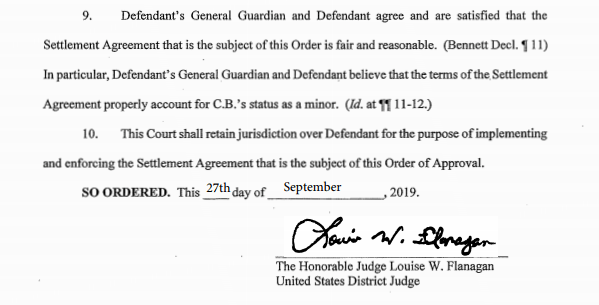
A discovery order signed September 19 by District Judge Lynn N. Hughes grants DISH permission to subpoena and obtain information from some of the world’s largest Internet companies that have done or are still doing business with Easybox.

The list is comprehensive and a potential eye-opener for other IPTV providers operating without cast-iron licensing agreements.

Top of the list is payment processor PayPal. The Easybox website is currently down for supposed maintenance but according to archive copies of the site, PayPal isn’t clearly listed as a payment option for direct customers. Nevertheless, the company is probably head of the list for good reason.

Second up is Google. Like many companies, Easybox is likely to have used Google in several ways but a cursory review of the site’s source reveals an analytics account and links to the now-defunct Google+.

On the domain front, DISH has permission to subpoena Washington-based domain name registrar Enom and domain registry Namecheap. The Easybox.tv domain has clear links to both and could provide useful information.

When it comes to hosting, Miami-based Netrouting Inc. makes an appearance. In common with the domain companies, these may also have valuable information for DISH.

Easybox’s Facebook and Twitter pages are no longer active. The former is listed as unavailable but the latter appears to have been suspended after violating the platform’s rules. But whatever the reasons for their demise, both companies are likely to have plenty of additional information to offer up.

Finally, DISH will be able to enter the physical world to request information from entities that appear to have distributed or sold Easybox IPTV devices. Michigan-based fulfillment company Xpert Fulfillment Inc., Finest Bargain Inc. (which appears to sell via Amazon), and Ace Discount Store are all listed and should expect calls for information soon.

“By November 4, 2019, DISH must replead this case identifying the defendant as Easybox IPTV. When the other defendants are identified, they may be named,” Judge Hughes concludes.

The discovery order can be obtained here (pdf)

Source: TF, for the latest info on copyright, file-sharing, torrent sites and more. We also have VPN reviews, discounts, offers and coupons.


Source link


This week we have three newcomers in our chart.

Spider-Man: Far from Home is the most downloaded movie.

The data for our weekly download chart is estimated by TorrentFreak, and is for informational and educational reference only. All the movies in the list are Web-DL/Webrip/HDRip/BDrip/DVDrip unless stated otherwise.

RSS feed for the articles of the recent weekly movie download charts.

This week’s most downloaded movies are:
Movie Rank Rank last week Movie name IMDb Rating / Trailer
Most downloaded movies via torrents
1 (2) Spider-Man: Far from Home 7.8 / trailer
2 (…) Fast & Furious Presents: Hobbs & Shaw 6.7 / trailer
3 (9) Toy Story 4 8.1 / trailer
4 (1) Dark Phoenix 6.0 / trailer
5 (3) John Wick: Chapter 3 – Parabellum 7.8 / trailer
6 (5) Avengers: Endgame 8.7 / trailer
7 (4) Aladdin 7.3 / trailer
8 (…) Running with the Devil 5.4 / trailer
9 (8) Godzilla: King of the Monsters 6.5 / trailer
10 (…) Annabelle Comes Home 8.0 / trailer

Source: TF, for the latest info on copyright, file-sharing, torrent sites and more. We also have VPN reviews, discounts, offers and coupons.


Source link


In 2011 and 2012, the US Navy began using BS Contact Geo, a 3D virtual reality application developed by German company Bitmanagement.

After some initial testing, the Navy agreed to purchase licenses, understanding that these could be used across its network, as long as the number of simultaneous users was limited to a few dozen.

Bitmanagement saw things differently. The software vendor said it never authorized this type of use. When the company was informed that the Navy had installed the software on 558,466 computers, that came as a surprise.

This stance was repeated in a Federal Claims Court complaint filed by Bitmanagement three years ago. The German company accused the US Navy of mass copyright infringement and demanded damages totaling hundreds of millions of dollars.

In the years that followed, both parties conducted discovery. Initially, most of the court documents were made public, but more recently they were shielded from public view. What we do know, however, is that a week-long trial took place in Washington in April.

Following the trial and the post-trial briefs, the Court has now decided to dismiss the copyright infringement claim against the US Government.

“Although Bitmanagement established a prima facie case of copyright infringement, the evidence shows that Bitmanagement authorized the U.S. Navy’s copying of BS Contact Geo version 8.001. Therefore, the Court finds in favor of Defendant, the United States, and Plaintiff’s Complaint is hereby dismissed,” the verdict reads.

In a detailed opinion and order, published this week, Senior Judge
Edward J. Damich explains how this conclusion was reached.

The dispute appears to have begun when the US Navy decided that it would like to run the software across its entire network. This meant that it would be installed on hundreds of thousands of computers, with “Flexera” software keeping track of the number of simultaneous users.

Bitmanagement didn’t offer such a license by default, so the Navy requested this option separately. These requests took place through a reseller, Planet 9 Studios, which complicated matters. After several back and forths, the Navy was convinced that it had permission, but Bitmanagement later disagreed.

What’s clear is that the Navy never had a direct contractual relationship with Bitmanagement, so there was no direct permission given. This means that the Court had to review the conversations and exchanges that took place, to determine which side was right.

Here, the Court concluded that it’s clear that Bitmanagement authorized the Navy to use the software across its network with the network use (Flexera) license.

The evidence shows that Bitmanagement itself offered a custom license and changed the software installer to be used with a Flexera license. Through email communication, the German software company was repeatedly informed about this intended use, which it confirmed.

In addition, Bitmanagement cited the Navy’s ‘networked’ use of its software to a potential customer, with the following statement.

“After five years of testing, approval for the use of the BS Contact Geo on 350,000 PCs of the US Navy took place in May 2013 and central distribution has begun. In a second step, the distribution of the BS Contact Geo on 800,000 PCs in the largest computer network in the world will take place.”

From the order and opinion

Based on these and many other pieces of evidence, the Court concluded that the US Government can’t be held liable for copyright infringement.

“Together, these interactions unequivocally show that Bitmanagement was not only aware that the Navy planned to install BS Contact Geo “across a broad spectrum of the NMCI realm” but also that Bitmanagement authorized such installations,” the Court writes.

This means that after three years the US Navy has successfully defended the piracy claims. Instead of a potential $600 million judgment in its favor, Bitmanagement has no other option than to retreat.

A copy of the order and opinion of Senior Judge Edward J. Damich of the United States Court of Federal Claims is available here (pdf).

Source: TF, for the latest info on copyright, file-sharing, torrent sites and more. We also have VPN reviews, discounts, offers and coupons.


Source link

Even though IPTV management system Xtream Codes was taken down as part of an EU anti-piracy operation last week things seem to have a turn of course. As we wrote in a previous article, a lot of nonsense were written at the time by the “old media” most probably in order to catch views and popularity. At the end of the day, a global conspiracy of black IPTV markets sells better than a local iptv provider in Italy. But in an unexpected turn, today Xtream Codes seem to have their website back.

Xtream Codes Website Message

Today if you visit the official website of Xtream Codes you will have the following message:

Our website and services are down due to a preventing examination from italian Authorities. The examination is about a small number of our clients located in Italy. We apologize for any inconvenience although we are not responsible.

Please note that any website or/and service is using our name is fake and we are not in any way associated with them.

Xtream-Codes Team

In regards to their message we also have mixed feelings. So unlike as all the media are reporting that the “brains” of the operation Black IPTV seem to be the owners of the Xtream Codes platform, already the authorities gave them back access to their website. And all this happened in less than a week. That already looks like a very positive thing towards Xtream Codes. But we also feel a little bitter-sweet when reading the part of “…although we are not responsible”. As privacy advocators we believe that they could have done a better job to make the platform more secure and of course legal. But that is also another issue for a discussion in the future…

Xtream Codes Scams

It is also worth mentioning that websites that claim to be the “New Xtream Codes” is utterly fake. They seem to be the usual scams that try to monetize on situations like these. So beware and pay attention to any fake sites, that is in case of course you ever used their platform.

The Xtream Codes Case Is Complicated

We as Dimitrology.com do not support any of the parts involved in this case. But we feel also that reporting the news should be neutral and as close as possible to the truth. And as we already have stated from our first article, this case is more complicated than it seems. Legally and to our understanding, Xtream Codes is merely a platform that can be used from various operators / iptv providers and as said before, a lot of them are totally legal. Since we are not investigators and the authorities for sure know what they are doing, we should wait to see what else they are gonna discover and what they already have in hand. And even then, there should be judge, not a police task force or the media that should rule the case.

Xtream Codes Speculations

There are voices that say that the whole case is an economic fraud, others that it was a tax issue and others that the platform is the brain of the IPTV black market. But at the end of the day they are just voices. The facts as we know them are also mentioned in a previous article so you can read further here. For now we can say that he have a lot more to see and a lot of more to come for this first of it’s kind case. It’s worth mentioning that because of the unique state of this case, there was also some manipulation – from the media mostly – in order to spread terror and fear.


Back in March, US-based author John Van Stry filed a copyright infringement lawsuit against Travis McCrea, the operator of eBook platform eBook.bike.

The direction of the case has been somewhat disorganized but rests on Van Stry’s basic claims that his books appeared on eBook.bike without his permission and weren’t taken down, resulting in breaches of copyright law.

McCrea, on the other hand, says that the DMCA notices he received from the author were deficient, meaning he has no case to answer. In August, a motion for default judgment filed by Van Stry was set aside, as was a motion to dismiss filed by McCrea. At that time, a trial date was provisionally set for June 2020.

This week, McCrea – who is defending himself – filed his answer to the 54-page complaint filed by Van Stry in March. In many respects it covers old ground, such as restating McCrea’s defense under the safe harbor provisions of the DMCA and reiterating the claim that Van Stry’s notices were deficient and thus contributed to any problems he may have faced.

Even more fundamentally, McCrea’s answer states that no evidence has been presented to the Court to back up Van Stry’s claim that eBook.bike ever advertised, imported, or distributed any copyrighted material. On that basis, McCrea denies all the claims to the contrary.

“No files have been submitted for evidence, nothing that proves that infringement actually happened at all, nothing that even shows the files were in fact on the servers,” he writes.

A significant portion of Van Stry’s original complaint focused on McCrea’s character and alleged previous conduct, describing him as having a “proud history of pervasive, blatant, and egregious violations of other persons’ intellectual property rights” as a key figure in the Pirate Party movement.

The complaint adds that McCrea was president/reverend of the Kopimist Church of Idaho – a spin-off from the pro-file-sharing Church of Kopimism which was recognized as a religion in Sweden back in 2012.

“‘Reverend’ McCrea is on record as having said that ‘giving away other people’s intellectual property’ is his ‘religious vocation’,” the complaint noted.

In his answer, McCrea says that none of these things should be taken as evidence that he breaks the law.

“[T]he Plaintiff shows that the Defendant is active politically but does not show a link between the political action and the Defendant’s desire to engage in illegal activities,” McCrea writes.

“The Defense accepts that the Defendant has both religious and political beliefs that deal with the concept of intellectual property laws. However, the 1st Amendment of the constitution protects the Defense for having political and religious beliefs.

“It is no more appropriate to allow the belief in Kopimism and the Pirate Party to be evidence for actually infringing in copyright as it would be to assume Baptists and/or a Republican are going to bomb an abortion clinic.”

Further underlining that someone’s religious beliefs don’t necessarily lead to them following every ‘rule’ to the letter, McCrea states that Leviticus 21:17-24 “essentially” tells follows to “shun ugly people” but Catholic Priests don’t do that. Jacob 2:24-30, he continues, references “plural marriage” but Mormons largely reject that because it’s illegal.

“You can believe in something without practicing it. The defense denies wrongdoing and will make a subsequent motion to have religious references struck from the case,” he adds.

But even with that said, McCrea cites religion as at least part of his defense. Noting that Van Stry has provided no proof of infringement and that in any event eBook.bike is protected under the DMCA, he accuses the author of introducing conjecture of a nature that potentially violates his human rights and ability to practice religion without persecution.

“An argument will be made that in a worst case scenario where the Defendant had failed to adequately address the copyright infringement per the DMCA it was only acting in a way to balance their religious beliefs against the societal laws that also bound them,” the answer reads.

“When a religion is acting without harm to those around them, leeway must be given to allow them to exercise their right to free expression as per the First Amendment.”

In closing, McCrea calls for Van Stry to “take nothing” and judgment to be awarded in his favor, including recovering all costs related to the lawsuit from the author and any additional relief the Court deems appropriate.

McCrea’s answer can be obtained here (pdf)

Source: TF, for the latest info on copyright, file-sharing, torrent sites and more. We also have VPN reviews, discounts, offers and coupons.



Source link

Last week the illicit IPTV market was thrown into turmoil when Italian authorities teamed up with law enforcement groups in the EU.

Their operation, dubbed ‘Black IPTV‘, targeted individuals and equipment behind at least one Italy-based IPTV provider. More importantly, however, it also targeted Xtream Codes, a management system utilized by many providers and sellers of IPTV services.

While Xtream Codes claimed to be a content-agnostic system, its popularity in the unlicensed market is hard to understate. With an estimated 5,000 providers of varying kinds on its books servicing around 50 million end-users, its closure had an immediate and dramatic impact.

In the immediate aftermath of the raids, suppliers reported an inability to sign up new customers or renew customer subscriptions. Within several hours, it became clear that anyone reliant on the system would be more seriously affected, with IPTV services going dark and paying customers seeing red.

As soon as news of the raids appeared on our radar, we contacted several previously responsive players in the IPTV market. Precisely zero responded to our requests for comment amid the chaos, which was widespread and by some estimates affected up to 90% of the market. Data from Google Trends does seem to indicate that plenty of people hit its search engine for news.

Google Trends Xtream Codes

With no obvious central source for information on the impact of the operation, the day after the raids TorrentFreak contacted Sandvine, a networking equipment company that has previously provided detailed analysis on general Internet and piracy-related traffic.

An external source that requested anonymity told us that due to technical issues the full force of the raid may not be felt until Thursday or Friday, the two days directly after the raids took place. So, we asked Sandvine if the company had noticed any significant drop in illicit streaming traffic during that period – it had.

This week a spokesperson for the company told TorrentFreak that on Friday September 20, Sandvine estimated that illicit streaming traffic had decreased 50% from the levels seen on Thursday, a massive drop by any standards.

That many illicit IPTV providers had been seriously affected by Xtream Codes’ removal from the market didn’t really come as a shock. Equally, it wasn’t really a surprise when providers began to adapt to the loss either.

Slowly but surely, some providers and sellers began migrating to alternative management systems, as detailed in emails to subscribers seen by TF. By Saturday, better news for them began to filter through, with services not only returning but also with subscriber payment and subscription information intact.

Sandvine gave TF a brief list of five providers, all of which went down completely between the 19th and 21st of September. By 21st/22nd all were recovering to a greater or lesser extent, with only one failing to return at all.

That being said, the overall market is huge, so it’s almost impossible to say how many have now returned, in whole or in part. It isn’t difficult to find complaints that services are still down even today but there are also several reports of providers that weren’t affected at all by the Xtream Codes situation.

Typically, there are individuals and groups out there trying to make hay even before the storm clouds have cleared. TF has heard of a handful of hopeful end-users who believed they were paying to access a service that was still up, only to have their ‘supplier’ cut and run.

Equally, we were pointed to a service that claims to be an Xtream Codes replacement but is probably nothing more than an elaborate scam. Since the prices were so high, we didn’t feel tempted to test that theory out.

On the other hand, real Xtream Codes alternatives are out there but how vulnerable they are to similar action will remain to be seen. In particular, one service seems happy to take orders and is reportedly in use by a number of previously stranded providers and resellers.

If nothing else, most of those in the chain should now be more prepared if there’s similar action in the future. Or less surprised at least.

Source: TF, for the latest info on copyright, file-sharing, torrent sites and more.


When Disney announced that it would launch its own streaming service, two years ago, some noted that this would keep piracy relevant.

People had just become used to having access to a broad movie and TV library in one or two places, and any increased fragmentation appeared to be a step backward.

Fast forward to 2019 and Disney is about to launch its new service. At the same time, more and more streaming subscription platforms are coming up with exclusive releases. If you want to see those, you have to sign up.

While that may not be a problem for some, there is an audience of millions who don’t want to or simply can’t pay for a handful of streaming subscriptions. This means that they have to pick the ones they want the most.

That’s the hard reality for modern consumers, at least, for those who don’t want to break the law.

As it turns out, many people are willing to cross the line, and the increased fragmentation of video streaming service is indeed driving people back to pirate sites. This problem may actually be worse than some think, based on new research that was just published by Broadband Genie.

The broadband comparison/advice site conducted a survey among UK streaming users and found that 18% confessed to using pirate sites on the side. However, this number could more than double to 37% if the legal streaming subscription market continues to fragment.

Credit: Broadband Genie

The cost of these services is the driving factor behind the findings. Two thirds (67%) of the surveyed UK streamers feel that they are already paying too much. The average expenditure is roughly £15 a month, where a maximum of £10 is seen as ideal.

Interestingly, those people who consider becoming pirates are not doing so without taking precautions. More than half (60%) of the prospective pirates say they will invest in a VPN to prevent copyright holders from tracing their steps.

Alex Tofts, Broadband Expert at Broadband Genie, notes that we’re still a long way from having all video entertainment in one place. People have options to save costs, through family discounts, for example. But instead, many people prefer to pay for a VPN so they can go the pirate route.

“It’s disheartening that consumers are prepared to turn to streams and file sharing to access the content they want. The price consumers are willing to pay is the equivalent of subscribing to one service,” Tofts says.

Rightsholders, meanwhile, keep repeating that availability is no longer a problem. They are right. In most countries, people can watch pretty much everything they want, but it comes at a price which, according to the survey, they are not willing to pay.

If fragmentation increases most people will still pay for legal services, but an increasing number will additionally use pirate services to watch content that’s otherwise only available at platforms they don’t have access to.

Availability is no longer the key issue. Instead, the focus has shifted to convenience and affordability. The prospect of signing up and using four or even five different streaming service is not affordable for many people, nor is it convenient.

The solution would be to provide universal access to a multitude of services through a single interface at a decent price. That’s what people also get at pirate sites. But this is easier said than done, as it won’t bring in enough revenue, at least not at the subscription rates we have now.

Source: TF, for the latest info on copyright, file-sharing, torrent sites and more. We also have VPN reviews, discounts, offers and coupons.


Source link


In common with most major countries around the world, Russia has problems with piracy, a situation its government is constantly trying to address.

In an effort to deter citizens from using illicit sources, Russia has already developed one of the most aggressive site-blocking regimes anywhere in the world. Thousands of sites are blocked by ISPs on copyright grounds, some permanently

Right now, it is also working on further legislative amendments that will compel search engines to query online databases to ensure that links to allegedly-infringing content are removed from indexes in a matter of minutes.

But while all of that plays out, a new survey carried out by security company ESET suggests that the problem is unusually deep-seated, with just a fraction of respondents stating that they always obtain content from licensed sources.

The study was carried out in September among 2,000 people who were asked, among other things, what type of content they pirate most often. ESET says that many users highlighted more than one type of content but there was a clear leader.

52% of respondents said that ‘cracked’ games are their content of choice, closely followed by 43% who obtain movies and TV shows from unlicensed sources. Just over a third (34%) say they prefer to listen to music from illegal platforms rather than their legal equivalents.

While ‘pirate’ eBook and similar sites have been the subject of several lawsuits in Russia to date, only 14% said that they obtain content from these services. Just under a fifth (19%) of respondents say they install ‘cracked’ software. Perhaps predictably, ESET points out that since malware can come with such releases, its products can come in handy.

Overall, just 9% of all respondents in the study admit to obtaining content exclusively from licensed sources, a pretty measly figure. However, the information released by ESET doesn’t reveal how many of the 91% are ‘dual buyers’, an omission that could prove crucial.

People who pirate content but also obtain some content from licensed sources have been an important factor in more detailed studies carried out elsewhere. These people are regularly viewed as potential converts to 100% legal consumption in the future while offering some hope that the piracy puzzle can be solved in time.

But of course, people in Russia have their own reasons to pirate and it’s the old boogeyman at the top of the list – cost. According to ESET, 75% of respondents said that high prices are the reason to pirate, with just over a third (34%) stating that legal services fall short of their requirements.

Interestingly, ESET says that 25% refuse to pay for licensed content on “ideological” grounds, although it doesn’t elaborate on what they might be. That’s followed up by 16% who say they prefer pirate content because payment systems utilized by legal providers are “inconvenient”.

Finally, while ESET Russia encourages people to comply with relevant anti-piracy laws, it predictably gets in a plug for its own products. Nothing that unlicensed products and ‘cracked’ games can sometimes come with unwanted extras, the company suggests using its anti-virus solutions to combat the threat.

Given the results of the study, there’s plenty of scope for sales, if the company can get anyone to pay.

Source: TF, for the latest info on copyright, file-sharing, torrent sites and more. We also have VPN reviews, discounts, offers and coupons.


Source link