
In this part we dig into the secret pre-history of Bitcoin, including the World War 2 origins of public/private key cryptography, how Proof Of Work was initially proposed as a means to fight spam, and how the ‘Extropian’ movement – which, Finn explains, stood for ‘more life, more energy, more time, more space, more money… more everything! – collected an uncanny number of the early engineers contributing to what would eventually become Bitcoin.
If there’s one key takeaway from this episode, it’s that there’s no one Satoshi Nakamoto — Bitcoin’s a bricolage of math, technology and ingenuity stretching back at least seventy years.
—
Steal This Show aims to release bi-weekly episodes featuring insiders discussing crypto, privacy, copyright and file-sharing developments. It complements our regular reporting by adding more room for opinion, commentary, and analysis.
If you enjoy this episode, consider becoming a patron and getting involved with the show. Check out Steal This Show’s Patreon campaign: support us and get all kinds of fantastic benefits!
Produced by Jamie King Edited & Mixedby Lucas Marston Original Musicby David Triana Web Productionby Eric Barch
https://dimitrology.com/wp-content/uploads/2017/12/worldfea.jpg2501200Dimitrologyhttps://dimitrology.com/wp-content/uploads/2019/11/WEBSITE-LOGO-2020-SMALL.pngDimitrology2019-10-04 09:28:262019-10-04 09:28:26Steal This Show S04E27: ‘‘The Secret Satoshis’’
President of the United States Donald Trump is well-known for his love of Twitter.
He currently has well in excess of 65 million followers and regularly uses the platform to promote himself and attack his critics.
Earlier today, Twitter erupted when a tweet by the President, which contained a video attacking the integrity of political rival Joe Biden, received some serious editing thanks to Twitter.
While the words “LOOK AT THIS PHOTOGRAPH!” remained, the actual video had been removed following a copyright infringement complaint.
No photograph to see…
Trump’s tweet contained a video that has been doing the rounds featuring a photograph central to the recent Biden/Ukraine controversy. However, the photograph itself wasn’t the reason the video was taken down by Twitter.
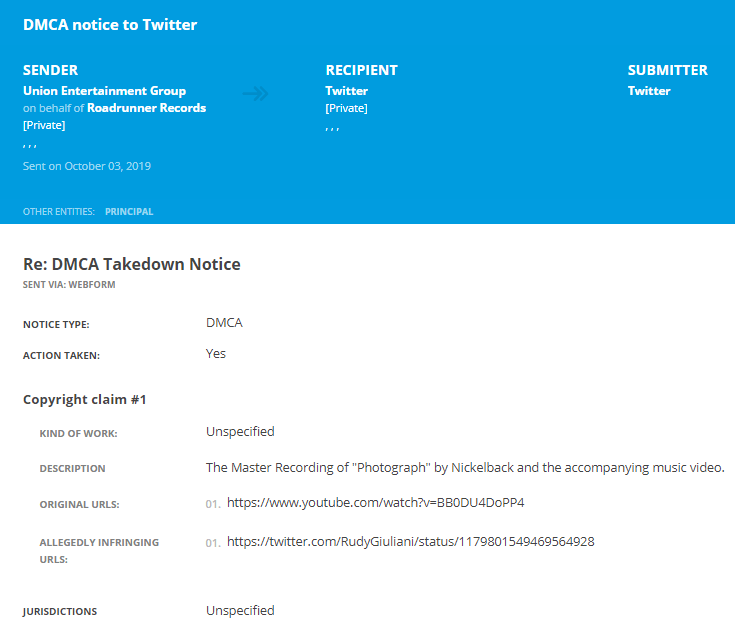
The viral video contains a clip from Nickelback’s 2005 video ‘Photograph’, prompting speculation that the band itself was behind the takedown sent to Twitter. While they may have had a hand in it, the actual DMCA served on Twitter and obtained by TorrentFreak reveals that the notice was sent by Warner Music.
The DMCA notice sent to Twitter by Warner Music (Lumen Database)
The cited source material for the takedown indeed points to the ‘Photograph’ video on YouTube, confirming the Nickelback link to the takedown.
Unfortunately, if Trump wanted to legally use the track in a political context, this would usually mean requesting permission from not only the publisher but also Nickelback, who may or may not wish to be associated with the effort. The copyright takedown suggests that the required pieces probably weren’t in place.
Perhaps the most interesting thing when one ignores the political angle of Trump’s tweet is that the President has been in this and similar positions several times before.
The Lumen Database, a repository to which Twitter sends its takedown notices, currently lists at least seven DMCA complaints filed against Trump this year alone, all of which have resulted in the removal of content.
On the other hand, people receiving DMCA notices from the IFPI, which acts as a copyright enforcer for Warner on Twitter and elsewhere, get their accounts terminated for fewer strikes. Perhaps there’s a presidential exemption from the DMCA repeat infringer policy at Twitter.
Notices filed against Trump on Twitter in 2019 can be found here 1,2,3,4,5,6,7 (pdf)
Update: The same video was uploaded to The White House YouTube channel. It was also taken down following a copyright complaint.
https://dimitrology.com/wp-content/uploads/2017/09/featcloud.jpg2501200Dimitrologyhttps://dimitrology.com/wp-content/uploads/2019/11/WEBSITE-LOGO-2020-SMALL.pngDimitrology2019-10-03 23:27:242019-10-03 23:27:24DMCA Notice Confirms Trump Tweet Was Taken Down By Warner Music
The effects that legal streaming services have on people’s motivation to pirate can be quite confusing.
On the one hand, legal services have been known to lower the piracy rates in some regions, but too many exclusive platforms could boost piracy again.
In South Africa, Internet providers are mostly noticing the first. Netflix first launched there in 2016, and since then, Netflix traffic has dwarfed BitTorrent traffic, ISPs say. While it’s not entirely clear to what degree torrent traffic decreased, if it did, the companies have all noticed a massive Netflix effect.
In a report published by Mybroadband, several ISPs were questioned about the topic. Without exception, they say that video services, Netflix in particular, have made BitTorrent traffic relatively insignificant.
RSAWEB, for example, noticed that Netflix traffic surged and that peak time data usage doubles every six months. This is in large part the result of a streaming boom. At the moment, the volume of Netflix traffic is 20x that of BitTorrent traffic.
“The ratios have significantly changed compared to a few years ago,” a RSAWEB spokesperson said. “The current ratio would be for every 50Mbps of aggregated torrent traffic we observe 1Gbps of aggregated Netflix streaming traffic.”
Webafrica noticed a similar trend, but perhaps even more pronounced. The company noted that during peak hours half of all traffic is generated by Netflix. BitTorrent traffic follows somewhere in the distance t the extent it’s not even worth tracking anymore.
“The growth of Netflix in recent years has been truly phenomenal, to the point where we no longer track torrent traffic separately,” Webafrica’s Greg Wright said. “Google (including Youtube) and Netflix are dominating the content currently,” he added.
Paul Butschi, co-founder of Internet provider Cool Ideas confirmed this trend. Netflix makes up roughly 30% of the company’s peak traffic and he believes that the increased popularity of online streaming had a pronounced impact on torrent traffic.
These opinions were largely shared by rival ISPs Cybersmart and Supersonic, with the latter noting that video streaming services have “completely overtaken the need for torrent sharing,” and that things will only get better if more competing services enter the market.
The last comment is something that’s up for debate, especially if new services all come with exclusive content. Looking at the relative traffic market share in North America over the past decade, a word of caution may be warranted.
Less than a decade ago nearly 20% of all traffic during peak hours was P2P related, mostly BitTorrent. As Netflix and other video streaming services grew, this relative share quickly dropped, but more recently it started to show signs of growth again.
It could be that people have started to pirate again because they can’t afford to pay for several paid streaming subscriptions.
This notion is supported by a recent survey which showed that piracy rates could potentially double again if the video streaming market continues to fragment. This can affect BitTorrent traffic, bus also pirate streaming sites and services, which the ISPs were asked about. These are the go-to piracy solution for most people nowadays.
Overall it’s safe to say that legal streaming services do indeed limit the demand for piracy, as the South African ISPs observe. This is particularly true if they’re convenient and affordable while providing access to a great content library.
https://dimitrology.com/wp-content/uploads/2019/10/netflix1.jpg2501200Dimitrologyhttps://dimitrology.com/wp-content/uploads/2019/11/WEBSITE-LOGO-2020-SMALL.pngDimitrology2019-10-03 13:26:252019-10-03 13:26:25Netflix has Dwarfed BitTorrent Traffic, South African ISPs say
Responding to a request from the Office of the US Trade Representative (USTR), the RIAA has submitted its annual list of “notorious markets.”
The submission identifies online and offline piracy hubs to help guide the U.S. Government’s position towards foreign countries when it comes to copyright enforcement.
“The online and physical markets identified in our comments are harming American creators, businesses, and the American economy,” writes George York, the RIAA’s Senior Vice President of International Policy.
Traditionally the online focus lies on classic pirate sites, such as torrent indexers, linking sites, cyberlockers, download portals, and stream-rippers. These are also listed in the latest RIAA submission. It includes many of the usual suspects, such as The Pirate Bay, Flvto, Newalbumreleases, and Uploaded.
While these mentions were expected, there’s also a new ‘issue’ highlighted by the music group – the encrypted messaging app Telegram. The software, which was launched by VKontakte founders Nikolai and Pavel Durov a few years ago, is frequently used by pirates, the RIAA notes.
The RIAA points out that messaging apps by themselves are of no special concern. However, Telegram also allows its users to share files of up to 1.5GB, a process that can be automated with scripts. This is a feature that many pirates have embraced.
“Telegram offers many user-created channels which are dedicated to the unauthorized distribution of copyrighted recordings, with some channels focused on particular genres or artists,” the RIAA notes.
Many of these files are hosted on Telegram’s servers and the RIAA says that it sent 18,000 DMCA notices to Telegram, identifying over 18,000 instances of copyright infringement.
The messaging app says that it forwards these requests to channel owners. However, according to the music group, this doesn’t have the desired effect, as many channel operators ignore the takedown requests. In addition, repeat infringers don’t appear to be punished in any way.
One of the many channels
“We have found, however, that most channel operators appear to take no action in response to our notices, with nearly all of infringements listed in our notices remaining available,” the RIAA writes.
“Likewise, Telegram makes no apparent attempt to verify that channel operators have complied with our notices and does not seem to have any kind of repeat infringement policy.”
By putting Telegram on the USTR’s agenda the RIAA hopes to, directly or indirectly, motivate the messaging app to do more to prevent piracy. Interestingly, Telegram is registered as both a UK LLP and an American LLC, so it’s not clear to us whether it’s indeed a “foreign” market from a US point of view.
Telegram is by no means new to piracy complaints. Two years ago the application also made the news when it, for the first time, removed an entire channel where a pirated copy of Taylor Swift’s album Reputation was shared. The service took this action following pressure from Google and Apple.
In addition to the issues discussed above, the RIAA’s submission mostly includes familiar topics. In this year’s ‘issue focus,’ the RIAA points out that malware remains a problem on pirate sites for example. This puts the public at risk and should be mitigated where possible, it says.
The music group also highlights problems with bulletproof hosting providers that ignore DMCA notices, and CDN services such as Cloudflare. In addition, it once again stresses that WHOIS data should become public and verified.
The USTR will use the input above to make up its own list of notorious markets. This will help to identify current threats while calling on foreign governments to take appropriate action.
—
A copy of the RIAA’s latest submission to the Office of the US Trade Representative is available here (pdf).
https://dimitrology.com/wp-content/uploads/2017/08/fea-dark-clouds.jpg2501200Dimitrologyhttps://dimitrology.com/wp-content/uploads/2019/11/WEBSITE-LOGO-2020-SMALL.pngDimitrology2019-10-03 03:25:322019-10-03 03:25:32RIAA Reports Telegram to US Govt. Over Piracy Concerns
Following intense pressure on local Internet companies, particularly search giant Yandex, last year an important meeting took place at the headquarters of Russian telecom watchdog Roscomnadzor.
Held between search engines and major copyright holders, the aim was to find a solution to the online proliferation of copyrighted content. By early November consensus had been reached, with Channel One, the National Media Group, Gazprom-Media, the Internet Video Association, the Association of Film and Television Producers, Yandex, Rambler Group, Mail.Ru Group, vKontakte, and RuTube signing up to a memorandum.
The voluntary agreement, which was timetabled to run until September 30, 2019, saw the creation of a centralized database of infringing content, maintained by rightsholders. Search companies agreed to query this database every few minutes in order to obtain the URLs of ‘pirate’ material so that they could be removed from search results.
Since the agreement was voluntary and time-limited, it was envisioned that the terms would be written into law, before the memorandum ran out. However, there have been a few points of contention, including a requirement from rightsholders that some continuously-infringing sites should be completely delisted from results, without a court process.
These things naturally take time to work out but in this case, too much time. On Monday, as per the original timetable, the memorandum expired. According to local news outlet RBC, the necessary amendments to copyright law were not submitted to the State Duma before that day, meaning that none of the signatories are bound by the agreement.
Sources at the companies involved told the publication that the memorandum has indeed timed-out but added that an informal agreement has now been reached by the parties to continue compliance for another two weeks. An extension of the agreement until December 31, 2019 had previously been agreed but its terms were not met by September 30.
According to Leonid Levin of the State Duma Committee on Information Policy, the bill to write the terms of the memorandum into law was submitted to the State Duma in a non-finished form. There will reportedly be another meeting between the parties this week.
“As soon as we finalize the document, it will be submitted to the State Duma,” Levin said. “Until then, we hope that all interested parties will continue to adhere to those provisions that were enshrined in the so-called anti-piracy memorandum, which meets all the interests of the industry.”
Roscomnadzor declined to comment on the delay but the Internet Video Association said that it would be “very disappointed” if Internet companies stopped removing links to pirated content due to the memorandum expiring.
At the moment, it appears that the memorandum is surviving on goodwill but according to reports the issue is in the balance. The so-called ‘repeat infringer’ clause, which would see sites permanently removed from search results, is still a point of contention moving into this week’s planned meeting.
https://dimitrology.com/wp-content/uploads/2018/03/russia-kremlin.jpg2501200Dimitrologyhttps://dimitrology.com/wp-content/uploads/2019/11/WEBSITE-LOGO-2020-SMALL.pngDimitrology2019-10-02 17:24:272019-10-02 17:24:27Russia Anti-Piracy Agreement Expires, Now Relies on Goodwill of Search Engines
Fast & Furious Presents: Hobbs & Shaw is the most downloaded movie.
The data for our weekly download chart is estimated by TorrentFreak, and is for informational and educational reference only. All the movies in the list are Web-DL/Webrip/HDRip/BDrip/DVDrip unless stated otherwise.
RSS feed for the articles of the recent weekly movie download charts.
https://dimitrology.com/wp-content/uploads/2017/08/keyboardfeat.jpg2501200Dimitrologyhttps://dimitrology.com/wp-content/uploads/2019/11/WEBSITE-LOGO-2020-SMALL.pngDimitrology2019-10-02 07:23:282019-10-02 07:23:28Top 10 Most Pirated Movies of The Week on BitTorrent – 09/30/19
Founded in 1994, Swedish Internet provider Bahnhof has been serving local Internet users for a quarter of a century.
During this time the company has fought hard to protect the privacy of its subscribers. This includes those who are accused of copyright infringement.
Unlike many other ISPs, Bahnhof aims to minimize its data logging practices only to the extent it is required to under the law. In recent years the ISP set up its logging policies in such a way that it can refuse requests for IP-address information from so-called copyright trolls, by deleting all relevant data after 24 hours.
The company based this practice on a European Court of Justice ruling which concluded that the European Data Retention Directive is invalid. However, data retention is now back under the spotlight.
After going back to the drawing board, Swedish lawmakers revised the Electronic Communications Act (LEK) to institute Swedish data retention requirements. This resulted in an amended law which goes into effect today, requiring all Swedish ISPs to keep detailed subscriber logs for at least 10 months.
For the Internet providers who already kept logs little will change, but Bahnhof sees it as a disaster. To minimize the privacy intrusions of its users the company has rolled out “Plan B.”
Starting today Bahnhof has no other option than to log individual IP-address allocations and other personal info for ten months. However, the company stresses that it will do so in a secure manner, making sure that it’s not available to the “copyright mafia.”
With the term “copyright mafia,” the company refers to the rightsholders who go after allegedly pirating Internet subscribers to demand settlements. Bahnhof has been a fierce opponent of this practice and ensures its customers that it won’t share any logs for this purpose.
“All Bahnhof customers can rest assured that their customer data is stored securely with us, that we delete after 10 months, and that we will never disclose information unless it’s in accordance with the Electronic Communications Act.
“This means that if someone else asks for customer data, including a court that handles civil litigation, we have nothing to disclose because our customers’ information is locked away as ‘safe intended for LEK’,” Bahnhof adds.
Not all ISPs have separated this data and that’s why many do comply with copyright holder requests. However, Bahnhof’s strict data policies ensure that only law enforcement agencies can request this info.
Still, Bahnhof is not happy with the mandatory data retention and will continue to protest the law whenever it can. In addition, it also points its customers to an alternative option through which they can ensure their privacy.
Bahnhof also offers a VPN service which is not required to keep any logs. If people use this, their IP-address information remains private. The VPN service was launched when earlier data retention requirements were put in place and is relevant once again.
“It is not enough to be a customer with us to be safe online, your subscription does not protect your data traffic automatically. You need to protect yourself and your data yourself with a VPN service as well,” Bahnhof writes.
While this sounds like a good opportunity to sell something ‘extra,’ the ISP is offering everyone a rather generous six-month free trial without any further obligations. After that, the costs are pretty reasonable as well, roughly $4 per month (SEK 40).
The six-month free VPN trial is open to anyone, which means that subscribers from other ISPs can try it as well.
https://dimitrology.com/wp-content/uploads/2018/12/ISP-Faces-‘Net-Neutrality’-Investigation-For-Pirate-Site-Blocking-Retaliation.png150222Dimitrologyhttps://dimitrology.com/wp-content/uploads/2019/11/WEBSITE-LOGO-2020-SMALL.pngDimitrology2019-10-01 21:22:252019-10-01 21:22:25ISP Bahnhof Must Log Subscriber Data, But ‘Copyright Mafia’ Won’t Get Any
Founded in 2013, Mega quickly grew to become one of the world’s dominant file-hosting and sharing platforms.
Launched by Kim Dotcom, who later appeared to distance himself from the site, Mega was promoted as a privacy solution, a place where files could be kept safe from prying eyes. However, in common with file-hosting sites of all kinds, some people use it to store copyrighted content, with large volumes being offered publicly.
This has created friction between Mega and some rightsholders, despite the former insisting that it does all it can within the law to respond to claims. Nevertheless, some rightsholders prefer the strong-arm approach.
During yesterday, reports from Brazil indicated that Mega had become inaccessible via some ISPs. The problem was spotted at Mega too, which tweeted to one ISP, Vivo, to sort out the issue.
“Hello @vivobr,” Mega wrote in Portuguese. “We are receiving reports from our users that Vivo is blocking https://mega.nz through a DNS block. Please rectify this as soon as possible! You are interfering with your customers’ Internet.”
Soon after, however, it became clear that Vivo and indeed additional ISPs weren’t in a position to do anything about the problem.
According to legal resource JusBrasil, there was a court process on September 12, 2019, which ordered four Internet service providers – Claro Brasil, Vivo-Telefonica, Oi and Algar Telecom – to prevent their subscribers from accessing 10 domains, including Mega.nz.
The most recognizable of the other nine domains is oload.tv, which appears to be a domain operated by file-hosting giant Openload. Last December, Vivo told a local publication that it had been forced to block Openload in Brazil following an earlier court decision but declined to provide additional details.
The rest of the list consists of Alfastream.cc, which doesn’t present itself as a regular hosting service but has URLs listed online which indicate content is available on the platform. Similarly, Akugyash.com only displays a brief message but elsewhere on the web is described as a video balancer.
Verystream.net is helpful in that it describes its function on its homepage as the CDN (Content Delivery Network) used by file-hosting site Verystream.com. Fembed.net and Ruvid.nl both point to the same file-hosting service with the former’s branding, with ClipWatching.com and VideoShare.club acting as file-storage sites.
The final and most strange domain on the list is centrelinguistique.com, which appears to be a French language school, which doesn’t fit the file-storage theme of the other domains in any way.
According to Brazil’s Technoblog, the details of the blocking case are being kept secret, which does nothing to unravel the language school mystery. However, it does claim to have identified ABTA – the Brazilian Association of Subscription Television – as the plaintiff in the matter.
Documents that are publicly available suggest that this is probably an expansion of an earlier ruling, with a note that the plaintiff requested an “extension” of an earlier action due to the “distributor and facilitator websites” adopting “new techniques to circumvent the blockages made by the providers.”
In any event, the operators of Mega feel that its domain has been blocked inappropriately.
“With respect to the block in Brazil, we respectfully believe that the order is wrong and that the Court has been misled,” the company wrote in Portuguese this morning.
“MEGA has excellent compliance. We are working on a solution. We apologize for the inconvenience and appreciate your patience!”
Whether that solution is legal or technical in nature isn’t yet clear. However, there are reports that the targeted ISPs are employing different blocking measures, with some targeting IP addresses (which can be bypassed using a VPN) and others meddling with DNS (which can be circumvented by using an alternative, such as OpenDNS).
There’s no mention of the action on the website of the Brazilian Association of Subscription Television but they do have a selection of ominous anti-piracy videos, one of which is embedded below.
https://dimitrology.com/wp-content/uploads/2018/04/roadblock-blocked-feat.jpg2501200Dimitrologyhttps://dimitrology.com/wp-content/uploads/2019/11/WEBSITE-LOGO-2020-SMALL.pngDimitrology2019-10-01 11:21:292019-10-01 11:21:29Mega.nz and Openload Blocked in Brazil Following Court Order
If one took a broad overview of the entire history of video gaming, few would dare to argue Nintendo’s legend status over the past several decades.
The Japanese company’s games, both old and new, are renowned for their brilliance and enduring characters. Arguably the most iconic is Mario, who first made his appearance as the hero in the timeless 1981 release Donkey Kong.
Even today, dangerously close to 40 years on, countless players still enjoy this and other classics on emulators and similar tools but Nintendo’s tolerance is becoming increasingly fragile. Over the past couple of years, as players toil in the shadows to defeat Kong, Nintendo has become a litigation machine throwing takedown notices and even lawsuits (1,2,3) at sites and alleged infringers.
The company’s latest effort came on Friday when it sent a copyright complaint to development platform Github. The target was a remake of Donkey Kong built with React Native, the open-source mobile application framework created by Facebook.
Created by developer ‘bberak’, this React Native version of Donkey Kong isn’t an emulation, it was created from the ground up for iOS and Android and documented in a detailed post on Hackernoon in April 2018.
The jumps and gameplay quirks reveal this is no emu
Perhaps a little unusually, given the risks associated with stepping on Nintendo’s toes lately, the original repo – which was now been taken down – basically acknowledges that parts of the project may infringe copyright. The game’s code may have been created independently but the visual and audio assets are undoubtedly Nintendo’s. And the repo happily pointed to the company behind the project too.
“Copyright Notice: All content, artwork, sounds, characters and graphics are the property of Nintendo of America Inc, its affiliates and/or subsidiaries,” the repo read.
“Get in Touch: We are Neap – a development and design team in Sydney. We love building stuff and meeting new people, so get in touch with us at https://neap.co.”
The Neap website reveals that ‘bberak’ is Boris Berak, co-founder and Technical Director of the Australia-based company. TF contacted them for comment but at the time of publication, we hadn’t received a response.
In hindsight, it was probably a mistake to use Donkey Kong as a technical demo since Nintendo has already shown an aversion to such projects in the past. Back in June 2017, the company targeted a Donkey Kong remake for Roku, also hosted on Github. Interestingly, the complaint filed Friday appears to have an artifact from that two-year-old notice.
Stating the content being targeted most recently, Nintendo states: “Nintendo’s Donkey Kong video game, covered by U.S. Copyright Reg. No. PA0000115040 (supplemented by PA0000547470). The reported repository contains a recreation of Nintendo’s Donkey Kong video game for Roku, which was created and published without Nintendo’s authorization.”
The text is an exact match with that in the earlier complaint, even going as far as referencing Roku, which appears to be an error. Nevertheless, those details are irrelevant to the claim and won’t be good grounds for a counter-notice.
As Nintendo’s notice points out, at least another 30 developers forked this Donkey Kong variant on Github, so all those repositories have been taken down too. They could probably be restored if Berak removed all the original Donkey Kong references, graphics, and sound, but that seems unlikely.
https://dimitrology.com/wp-content/uploads/2019/10/donfea.jpg2501200Dimitrologyhttps://dimitrology.com/wp-content/uploads/2019/11/WEBSITE-LOGO-2020-SMALL.pngDimitrology2019-10-01 01:20:332019-10-01 01:20:33Nintendo Takes Down Facebook-Tooled Donkey Kong Remake
At the time, the torrent site was at the center of a high profile copyright infringement lawsuit, something the social media network didn’t want to be associated with.
Perhaps unsurprisingly, The Pirate Bay wasn’t very cooperative. The request remained unanswered which left Facebook with no other option than to block Pirate Bay URLs at its end.
“The Pirate Bay has not responded and so we have blocked their torrents from being shared on Facebook,” the company told us at the time.
Today, more than a decade later, the “share” button on The Pirate Bay is long gone. Somewhere during this period, Facebook’s ban was also lifted. When the social media site started blocking several other torrent sites a few weeks ago, we noticed that TPB was not among them.
However, this changed recently. When we reviewed Facebook’s blocking efforts a few days ago we noticed that The Pirate Bay is now blocked as well. Similar to the other pirate sites, it apparently violates the platform’s “community standards.”
People who want to use Facebook to post a link to The Pirate Bay will see the following error message instead; “You can’t share this link. Your post couldn’t be shared, because this link goes against our Community Standards.”
Similarly, all Pirate Bay links are blocked in Facebook’s Messenger chats as well, returning a similar notification.
Facebook’s Community Standards and its Terms of Service allow the platform to take action against potential intellectual property infringements, which is likely what triggered this action.
While The Pirate Bay is now blocked again by Facebook, the current ban is substantially different from the previous one. Ten years ago the site only prevented people from linking to actual torrent pages, while all URLs, including the homepage, are banned today.
It is apparent that Facebook is gradually expanding its ‘piracy’ blocking efforts. In addition to adding The Pirate Bay, 1337x.to was recently added as well, and it wouldn’t be a surprise if more URLs will follow.
https://dimitrology.com/wp-content/uploads/2018/01/facebook-feat.jpg2591056Dimitrologyhttps://dimitrology.com/wp-content/uploads/2019/11/WEBSITE-LOGO-2020-SMALL.pngDimitrology2019-09-30 15:19:322019-09-30 15:19:32Facebook Blocks Users from Sharing Pirate Bay Links