
This week Disney launched its new streaming platform which immediately gained millions of subscribers.

At the same time, there was plenty of interest in ‘unauthorized’ Disney+ releases on pirate sites, particularly in the exclusive Mandalorian series.

As one of the largest entertainment companies in the world, Disney is not new to piracy. It has dealt with this issue for decades. However, now that it operates its own exclusive platform there are other factors to take into account.

How do exclusive releases impact piracy rates, for example? And what is the effect on subscriber rates? How the interplay between legal and illegal supply affects revenues can be a complex and dynamic puzzle to solve.

What is clear is that Disney has the goal to minimize piracy. While it’s not publicized much, the company has a dedicated “piracy intelligence” team that continually keeps an eye on the piracy landscape.

Just recently, a new vacancy opened up, perhaps tied to the launch of Disney+. While there are few details available, Disney describes the team as follows:

“The Piracy Intelligence team at The Walt Disney Studios is based in Burbank and provides meaningful piracy insights to inform strategies that maximize revenue for the film and TV business and minimize the piracy impact.”

Disney is currently looking for a market research and data analyst, who will be responsible for supporting a variety of “piracy intelligence initiatives” and to “measure movie and TV viewing trends across digital media platforms.”

Unfortunately, there is not much information online about the goals and accomplishments of Disney’s anti-piracy team. TorrentFreak reached out to multiple contacts at the company, but thus far we have yet to receive a response.

It’s no secret, however, that major entertainment companies keep a close eye on the pirate landscape.

The enforcement side of this is often quite visible. This is also true for Disney. The company is a member of the global anti-piracy coalition ACE, which has filed several lawsuits and chases site owners and developers as well.

However, piracy “intelligence” can also be used as a valuable market signal. That aspect would be more in line with the “market research” and “data analyst” Disney is currently looking for.

This type of piracy use wouldn’t be unique. Previously we reported how Netflix uses piracy to figure out how much they can charge in a country, as well as what content they license. Similarly, Hulu uses piracy data to see what is popular among potential viewers.

Disney may use similar signals to determine how to best position Disney+ and what content it should offer to minimize piracy, and perhaps more importantly, maximize revenue.

While I have no intention of applying for the job, one free bit of advice is to make sure that Disney+ is available everywhere in the world. Right now, many people feel left out which makes pirated Disney+ exclusives quite tempting.

But I guess the intelligence team will notice that soon enough.

Source: TF, for the latest info on copyright, file-sharing, torrent sites and more. We also have VPN reviews, discounts, offers and coupons.




Source link


During the summer we reported on the renewed efforts of Golden Eye (International) and Mircom, companies with a track record of targeting alleged BitTorrent pirates with demands for cash settlements to make supposed lawsuits disappear.

After filing no complaints in the UK for years, the pair teamed up in an effort to squeeze the personal details of thousands of Internet users from the hands of ISP Virgin Media. Somewhat unusually given previous compliance in alleged anti-piracy matters, Virgin put up a pretty big fight.

In the end, the cases brought by Golden Eye and Mircom were proven to be so lacking in evidence that a judge in the High Court threw out the companies’ claims. Nevertheless, there are more countries than just the UK to target.

Cyprus-based Mircom (full name Mircom International Content Management & Consulting) has another case on the boil, this time against Telenet, the largest provider of cable broadband in Belgium. In common with previous cases, this one is also about the unlicensed sharing of pornographic movies using BitTorrent.

Mircom says it has thousands of IP addresses on file which can identify Telenet subscribers from which it wants to extract cash payments. However, it needs the ISP’s cooperation to match the IP addresses to those customers and the case isn’t progressing in a straightforward manner.

As a result, the Antwerp Business Court (Ondernemingsrechtbank Antwerpen) has referred several questions in the matter to the European Court of Justice. As usual, there are several controversial as well as technical points under consideration.

The first complication concerns how BitTorrent itself works. When a regular user participates in a BitTorrent swarm, small downloaded parts of a movie are then made available for upload. In this manner, everyone in a swarm can gain access to all of the necessary parts of the movie.

Anyone who obtains all of the parts (and therefore the whole movie) becomes a ‘seeder’ if he or she continues to upload to the swarm.

However, a question with three parts sent to the EU Court appears to seek clarity on whether uploading small pieces of a file, which are unusable in their own right, constitutes an infringement and if so, where the limit lies. It also deals with potential ignorance on the user’s part when it comes to seeding.

1. (a) Can the downloading of a file via a peer-to-peer network and the simultaneous provision for uploading of parts (‘pieces’) thereof (which may be very fragmentary as compared to the whole) (‘seeding’) be regarded as a communication to the public within the meaning of Article 3(1) of Directive 2001/29, (1) even if the individual pieces as such are unusable? If so,

1. (b) is there a de minimis threshold above which the seeding of those pieces would constitute a communication to the public?

1. (c) is the fact that seeding can take place automatically (as a result of the torrent client’s settings), and thus without the user’s knowledge, relevant?

While the above matters are interesting in their own right, it’s Mircom’s position that perhaps provokes the most interest and has resulted in the next pair of questions to the European Court of Justice.

To be clear – Mircom is not a content creator. It is not a content distributor. Its entire purpose is to track down alleged infringers in order to claim cash settlements from them on the basis that its rights have been infringed. So what rights does it have?

Mircom claims to have obtained the rights to distribute, via peer-to-peer networks including BitTorrent, a large number of pornographic films produced by eight American and Canadian companies. However, despite having the right to do so, Mircom says it does not distribute any movies in this fashion.

Instead, it aims to collect money from alleged infringers, returning a proportion of this to the actual copyright holders, to whom it paid absolutely nothing for the rights to ‘distribute’ their movies via BitTorrent.

Interesting to say the least, a situation that has resulted in a second question with two parts being referred to the EUCJ;

2. (a) Can a person who is the contractual holder of the copyright (or related rights), but does not himself exploit those rights and merely claims damages from alleged infringers — and whose economic business model thus depends on the existence of piracy, not on combating it — enjoy the same rights as those conferred by Chapter II of Directive 2004/48 (2) on authors or licence holders who do exploit copyright in the normal way?

2. (b) How can the license holder in that case have suffered ‘prejudice’ (within the meaning of Article 13 of Directive 2004/48) as a result of the infringement?

A third question asks whether the specific circumstances laid out in questions 1 and 2 are relevant when assessing the correct balance between the enforcement of intellectual property rights and the right to a private life and protection of personal data.

Finally, question four deals with a particularly interesting aspect of BitTorrent swarm data monitoring and subsequent data processing in respect of the GDPR.

4. Is, in all those circumstances, the systematic registration and general further processing of the IP-addresses of a ‘swarm’ of ‘seeders’ (by the licence holder himself, and by a third party on his behalf) legitimate under the General Data Protection Regulation and specifically under Article 6(1)(f) thereof?

There are already considerable concerns that the tracking data collected and processed as part of the case in hand may not have been handled as required under the GDPR. That, on top of the conclusion that Mircom fits the ‘copyright troll’ label almost perfectly, makes this a very interesting case to follow.

Source: TF, for the latest info on copyright, file-sharing, torrent sites and more. We also have VPN reviews, discounts, offers and coupons.



Source link


In February, several major Hollywood studios filed a lawsuit against Omniverse One World Television.

Under the flag of anti-piracy group ACE, the companies accused Omniverse and its owner Jason DeMeo of supplying of pirate streaming channels to various IPTV services.

Omniverse sold live-streaming services to third-party distributors, such as Dragon Box and HDHomerun, which in turn offered live TV streaming packages to customers. According to ACE, the company was a pirate streaming TV supplier, offering these channels without permission from its members.

Omniverse disagreed with this characterization and countered that it did everything by the book. It relied on a deal from the licensed cable company Hovsat, which has a long-standing agreement with DirecTV to distribute a broad range of TV-channels with few restrictions.

Omniverse

As time went on, however, it transpired that the streaming provider was clearly worried about the legal threat. After several of its distributors distanced themselves from the service, Omniverse decided to wind down its business.

The streaming provider also filed a third-party complaint (pdf) against Hovsat for indemnification and breach of contract, among other things. Omniverse believed that it was properly licensed and wants Hovsat to pay the damages for any alleged infringements if that was not the case.

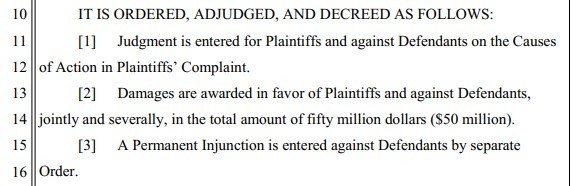
That there are damages became crystal clear yesterday, when ACE announced that it had obtained a consent judgment against Omniverse. Both parties have agreed to settle the matter with the streaming provider committing to pay a $50 million settlement.

“Damages are awarded in favor of Plaintiffs and against Defendants,
jointly and severally, in the total amount of fifty million dollars,” the proposed judgment reads.

The agreement also includes a permanent injunction that prevents Omniverse and its owner Jason DeMeo from operating the service and being involved in supplying or offering pirate streaming channels in any other way.

The damages amount of $50 million is a substantial figure. In the past, however, we have seen that the public figure can be substantially higher than what’s agreed in private. In any case, Omniverse may hold Hovsat accountable, as previously suggested.

Karen Thorland, Senior Vice President at the Motion Picture Association, which has a leading role in the ACE coalition, is pleased with the outcome.

“This judgment and injunction are a major win for creators, audiences, and the legitimate streaming market, which has been undermined by Omniverse and its ‘back office’ piracy infrastructure for years,” Thorland, says

Over the past years, ACE has built a steady track record of successful cases against IPTV providers and services. In addition to Omniverse, it also helped to shut down SetTV, Dragon Box, TickBox, Vader Streams, and many third-party Kodi addons.

The consent judgment and permanent injunction (pdf) have yet to be signed off by the court but since both parties are in agreement, that’s mostly a formality.

Source: TF, for the latest info on copyright, file-sharing, torrent sites and more. We also have VPN reviews, discounts, offers and coupons.



Source link


While movie and music companies have regularly filed copyright lawsuits against alleged BitTorrent pirates over the past decade and beyond, the companies operating the machinery behind the scenes are less well known.

One exception was to be found in GuardaLey, an entity that provided tracking data and business structure for numerous lawsuits, notably the massive action targeting alleged pirates of the movies The Hurt Locker and The Expendables.

While these lawsuits and others like them attracted plenty of headlines, GuardaLey itself rarely experienced much scrutiny, at least not to the extent where its complex business dealings were made available to the public.

Earlier this year the waters appeared to be muddied again when 100% of its alleged US-operations were ‘acquired’ by American Films Inc. which promised to target peer-to-peer networks in order to target “repeat infringers.”

Since then, nothing has been heard of American Films Inc, which at the time of the GuardaLey acquisition was described as a “shell company.” Now, however, the company appears to have even grander plans after another acquisition, this time of “strategic data company” Maker Data Services LLC.

“This acquisition is important because it adds to the evidence of BitTorrent related copyright infringement that American Films can provide to its clients,” says John Carty, American Films’ CEO.

“This type of forensic evidence is only available from a few sources, most of which only supply the largest industry associations.”

However, it’s the next set of claims that are likely to raise the most eyebrows, including a veiled threat to not only take powerful Internet service providers to court, but also VPN companies.

“American Films has positioned itself as the go-to data provider for independent filmmakers that want to take action against the direct infringers, Internet Service Providers, VPN Providers, and others that allow, encourage, and profit from BitTorrent copyright infringement,” a company statement reads.

According to various sources, at the time of writing American Films stock is currently changing hands at around $0.04, has one employee, but decides not to supply any financial information by way of accounts.

More information is available on Maker Data Services LLC if one visits its website, but it’s not a particularly confidence-inspiring experience, even for a one-year-old company.

“Our company has created a tool that will search the internet. Our tool is able to find any relevant data that could affect the operations of our clients, that is, the businesses we serve,” the Maker Data site reads.

“We deal mostly with real estate data and people data to ensure that Real Estate businesses have all the vital information to make sound decisions and drive their businesses forward.

“Our real estate data and analytics services will always give you the actual value of a home before buying for better decision making.”

While there might potentially be some synergies between the above and “forensic” anti-piracy activity, the claim elsewhere on the site that the company has “state-the-art software” does not extend to the bug-ridden WordPress installation powering the site.

Every page displays database errors and much of the site consists of ‘articles’ carrying little more than placeholder posts, graphics and text, presumably put there by the creators of the website.

Google “site:makerdataservices.com” for many more..

Along with the acquisition of Maker Data Services comes the appointment of a new CTO for American Films, Craig Campbell, formerly of Fidelity Investments.

His “main focus” will be “managing the build-out of BitTorrent products for copyright enforcement utilizing the combined data resources now available at American Films.”

How the business model of American Films will develop is for the future to reveal but the acquisitions announced by the company thus far only raise more questions, not provide more answers. To be brutal, it’s only the inclusion of GuardaLey’s reputation as a ‘copyright troll’ within the equation that provokes curiosity.

Litigating successful lawsuits against powerful ISPs or even VPN providers seems not only an incredibly lofty goal, but also an extremely costly and risky proposition. Part of the solution to the latter pair of roadblocks, perhaps, lies in the company’s stated aim.

“American Films seeks to create alternative investment participation vehicles that provide necessary funding to appropriate projects while offering reasonable return on investment and mitigation of business risks traditionally encountered in the film industry,” the company states.

A for-hire firewall for ‘copyright trolling’ or the next Rightscorp? Only time will tell but ISPs and VPN providers probably aren’t worried too much just yet.

Source: TF, for the latest info on copyright, file-sharing, torrent sites and more. We also have VPN reviews, discounts, offers and coupons.


Source link

Downloader App for Android TV devices like the Nvidia Shield TV, Xiaomi Mi Box, Sony TV, Philips, TCL, etc is back on the Google Play Store. But finding the Downloader app is a little tricky right now. So in this video I will show you how to easily find the Downloader app and install it on your Android TV device. And if it is the first time you use the Downloader application and you are new to the Android TV world, I will also show you how to install an application, sideload to be exact. In this example I’m gonna use the Puffin TV Browser, the fixed version that can still download files on your Android TV device.


The link I used for the Puffin TV Browser that can download files on Android TV: http://dimitrology.com/puffintv
More apps for Android TV: https://dimitrology.com/android-apk

Google Dislikes Sideload

The thing is that Google doesn’t want users to sideload apps anymore. They made it clear that they do not like apps that give users the ability to download apps outside from the Google Play Store for Android TV. That means that also the new version of Downloader may be at risk. My personal advice, hurry up to get it before it’s gone again!

Subscribe For More: https://goo.gl/hDiwEg
Dimitrology Youtube Channel: https://goo.gl/dbo6IL

Android TV Box / Streaming devices:
Recommended TV Boxes: http://wp.me/p6WCol-mz
Recommended Remotes: http://bit.ly/2akQuTR
Best Value/Money Gamepad: http://bit.ly/2a0scxA

My recommendations for 100% secure VPN are:
IP Vanish http://bit.ly/1PowS0r
Private Internet Access http://bit.ly/2a2H5gW

My Setup:
https://kit.com/dimitrology/my-setup

Contact Me:
Twitter – https://twitter.com/dimitrology
Facebook – https://www.facebook.com/dimitrology/
Instagram – https://www.instagram.com/dimitrology/
Reddit – https://www.reddit.com/r/dimitrology/
Email – [email protected]
Website – https://dimitrology.com

This video is about the Downloader App Is Back On Android TV – How To Find & Install It
https://youtu.be/FUiQl_EryWg


Over the past several years, independent photographers have filed more than a thousand lawsuits against companies that allegedly use their work without permission.

As many targets are mainstream media outlets, these can be seen as David vs. Goliath battles. However, the nature of these cases is described as classic copyright-trolling by many.

The driving force behind this copyright crusade is New York lawyer Richard Liebowitz, a former photographer, who explained his motives to TorrentFreak when he just got his firm started more than three years ago.

“Companies are using other people’s hard work and profiting off of it. It is important for photographers and the creative community to unite and stand up for their rights and protect their work,” Liebowitz said.

In the years that followed Liebowitz filed hundreds of new cases a year, trying to obtain settlements. While many of the photographers have a legitimate claim, the lawyer’s antics were increasingly criticized both in and outside of court.

In recent weeks, things only got worse.

In a case that was filed on behalf of photographer Jason Berger, targeting Imagina Consulting, Liebowitz failed to show up at a discovery hearing last April, without informing the court.

The lawyer later explained that this was due to a death in his family. However, since there were other issues that put the lawyer’s credibility in doubt, Judge Cathy Siebel decided to request evidence or documentation regarding who died, when, and how he was notified.

In the following months, Liebowitz explained that his grandfather had passed away on April 12, but he didn’t provide any documentation to back this up. Even after the court imposed sanctions of $100 for each business day he didn’t comply, nothing came in.

Instead of providing proof, the lawyer appeared to keep stalling, while stating that a death certificate is a personal matter.

This led some people to wonder whether Liebowitz’ grandfather had indeed passed away. Frustrated with the refusal to comply with her demands, Judge Siebel raised the sanctions to $500 per day earlier this month, criticising the lawyer for his behavior.

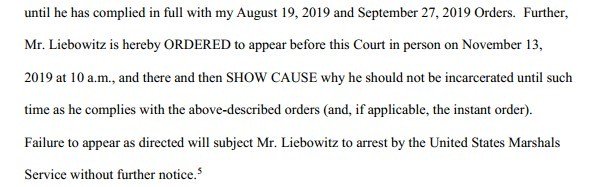
The order (pdf), picked up by Law360, instructed the New York lawyer to show up in court this week, to explain “why he should not be incarcerated” until he provides documented proof.

“Failure to appear as directed will subject Mr. Liebowitz to arrest by the United States Marshals Service without further notice,” Judge Siebel wrote.

It turns out that an arrest wasn’t needed as Liebowitz did show up at the hearing this week. Realizing that there may be trouble ahead, he entered the courtroom with two criminal defense lawyers at his side, for what would become a turbulent hearing.

After six months, the lawyer finally presented the death certificate the court had requested. This proved that he didn’t lie about the death of his grandfather, but he hadn’t been truthful either as this occurred three days earlier than Liebowitz said, on April 9.

Judge Siebel wasn’t happy about this, to say the least. According to The Smoking Gun, which covered the case in detail, she said that Liebowitz “chose to repeat that lie six, eight, ten times” as part of a “long-term campaign of deception.”

“I question Mr. Liebowitz’s fitness to practice,” Seibel added at one point during the hearing.

Liebowitz’s lawyer, Richard Greenberg, who has known the lawyer and his family for years, explained that his client’s misrepresentations were not “intentional” and that he “was in a daze” following the death of his grandfather.

However, Judge Seibel didn’t fall for this and countered that it would be “completely implausible” that this “haze” would have continued for months. According to her, Liebowitz intentionally lied to the court, noting that it was clearly not an honest mistake.

Greenberg also tried to get the sanctions lowered, which he said had risen to $3,700 over the past weeks. According to a letter sent to the court earlier this week, the attorney noted that Liebowitz had already paid a high price for his wrongdoing, including bad publicity.

“Richard has suffered horrible publicity as a result of being held in contempt and threatened with incarceration by this Court. And of course Richard, a young and inexperienced lawyer, is scared of the damage to his professional career as a result of his conduct and these proceedings,” Greenberg wrote.

“At the risk of appearing to minimize the seriousness of this matter, which counsel would not dare to do, counsel urges this Court to find that Richard has suffered or been penalized enough for his lapse or misconduct,” the letter (pdf) adds.

Judge Seibel didn’t seem convinced by these arguments though, and Liebowitz had to cough up for sanctions. According to Leonard French’s coverage, he paid $3,700 in court. That was $100 short according to the Judge, but she accepted it nonetheless.

The earlier contempt rulings also bring more bad news for the lawyer. He now has to disclose these to other courts as well as prospective clients, which likely doesn’t help his business.

In addition, Judge Seibel has referred the matter to the Grievance Committee, which will decide if further sanctions are appropriate, which could lead to trouble at the New York bar.

Needless to say, this is yet more bad news for the attorney. He can continue to practice law, at least for now, but everyone seems to agree that the attorney needs help and not just on the legal front.

Liebowitz’s own lawyer and family friend, Greenberg, recommended him to enroll in a CLE course to learn how to manage a small law firm. In addition, he was advised to seek psychotherapy to deal with several other issues.

Source: TF, for the latest info on copyright, file-sharing, torrent sites and more. We also have VPN reviews, discounts, offers and coupons.



Source link


Movie studio Voltage Pictures is no stranger to suing BitTorrent users.

The company and its subsidiaries have filed numerous lawsuits against alleged pirates in the United States, Europe, Canada and Australia, and likely made a lot of money doing so.

Voltage and other copyright holders who initiate these cases generally rely on IP addresses as evidence. With this information in hand, they ask the courts to order Internet providers to hand over the personal details of the associated account holders, so the alleged pirates can be pursued for settlements.

In Canada, Voltage tried to get these personal details from a large group of copyright infringers by filing a reverse class-action lawsuit, which is relatively rare. The movie company argued that this is a cheaper way to target large numbers of infringers at once.

The lawsuit in question was initially filed in 2016 and dragged on for years. The case revolves around a representative defendant, Robert Salna, who provides WiFi services to tenants. Through Salna, Voltage hoped to catch a group of infringers.

As the case went on the Canadian Internet Policy and Public Interest Clinic (CIPPIC) took interest in the case. The group, which is connected to the University of Ottawa, eventually intervened to represent anonymous defendants.

Among other things, CIPPIC argued that the movie company failed to identify an actual infringer. It targets multiple ‘infringing’ IP-addresses, which are not unique and can be used by multiple persons at once. In addition, unprotected WiFi networks may be open to the public at large.

Since the IP-addresses are not necessarily the infringers, Voltage has no reasonable cause to file the reverse class action, CIPPIC’s submission argued.

This week the Federal Court of Canada ruled on the matter and Justice Boswell agreed with CIPPIC.

“I agree with CIPPIC’s submissions that Voltage’s pleadings do not disclose a reasonable cause of action with respect to primary infringement.  While Voltage alleges that its forensic software identified a direct infringement in [sic] Voltage’s films, Voltage has failed to identify a Direct Infringer in its amended notice of application,” he writes.

Judge Boswell also agreed with CIPPIC’s critique of the class action procedure. These piracy cases deal with multiple infringers which will all have different circumstances. Reverse class action lawsuits are less suited to this scenario.

“A class proceeding is not a preferable procedure for the just and efficient resolution of any common issues which may exist.  The proposed proceeding would require multiple individual fact-findings for each class member on almost every issue.” 

The Judge further notes that there are other preferable means for Voltage to pursue its claims. These include joinder and consolidation of individual claims.

Based on these and other conclusions, Judge Boswell dismissed Voltage’s motion to certify the case as a reverse class action. In addition, the movie company was ordered to pay the costs of the proceeding, which could run to tens of thousands of dollars.

This is an important ruling as it takes a clear stand against the reverse class action strategy for this type of piracy case. And it may even go further than that. According to law professor Michael Geist, it can impact future file-sharing cases as well. 

“I think the decision does have implications that extend beyond this specific class action strategy as it calls into doubt the direct link between IP address and infringement and raises questions about whether merely using BitTorrent rises to the level of secondary infringement,” Geist tells TorrentFreak.

CIPPIC’s director David Fewer is also happy with the outcome. He tells the Globe and Mail that if the motion was accepted, it could have “seriously expanded the threat of copyright liability to anyone allowing others to use an internet connection.”

While the ruling is a clear dismissal of the reverse class action approach, there are similar file-sharing cases in Canada that have proven to be more effective. As long as this practice remains profitable, it will probably not go away.

A copy of Judge Boswell’s order is available here (pdf).

Source: TF, for the latest info on copyright, file-sharing, torrent sites and more. We also have VPN reviews, discounts, offers and coupons.



Source link


Being involved in the development of third-party Kodi addons and ‘builds’ (Kodi installations pre-customized with addons and tweaks) is a somewhat risky activity.

Providing simple access to otherwise restricted movies and TV shows attracts copyright holders, and that always has the potential to end badly. And it does, pretty regularly.

On November 1, 2019, UK-focused Kodi platform KodiUK.tv made an announcement on Twitter, stating briefly that “Something has happened this morning. Sorry!” While that could mean anything, an ominous follow-up message indicated that a statement would be released in due course “detailing the future”.

Several hours later, KodiUK.tv confirmed what fans already knew, that it had taken down its site. Why that happened remained open to question but a few hours ago the group confirmed that legal action was to blame.

“We took our website offline 10 days ago closed our repo and the builds due to legal demands against us,” KodiUK.tv announced on Twitter.

“We will say more when we can bring the site back up safely. But the builds & repo will not be back nor will we host any add-ons anymore for anyone.”

dad life kodi build

The closure is particularly bad news for anyone who used the popular DadLife Kodi build that was previously installable via the group’s repository. Whether it will find a new official home somewhere else is open to question.

But there is more bad news too. In an announcement posted a few hours ago to its Facebook page, Kodi builds and addon repository OneNation revealed that it too had shut down, again as a result of legal pressure.

“Unfortunately due to outside Legal pressures this group will close with immediate effect along with our Repository etc. We would just like to thank each and every one of you for all your support over the years,” OneNation wrote.

Noting they’d had an “absolute blast”, OneNation added they were going out with their “heads held high” having done things their way, without “robbing links from others” or accepting payment in any “shape or form”.

OneNation: another one bites the dust

OneNation went down with strict instructions for no-one to contact the team for any further information and to treat any additional information published online as “hearsay.” That means that confirming who applied the legal pressure will be reliant on word from the anti-piracy groups most likely to be have been involved.

TorrentFreak has contacted the Alliance for Creativity and Entertainment and the Federation Against Copyright Theft (FACT) for comment. We’ll post an update here if any confirmation or denials are received from either group.

Update: FACT has confirmed that it was indeed behind the action. TF is informed that the anti-piracy group sent notices to individuals engaged in running these and other as-yet-unnamed groups. In this round of action, the players were chosen based on their size and volume of activity.

“Our message is clear and consistent; we will act to prevent pirated content appearing on illicit streaming devices. FACT continues to monitor channels used to advertise, market, sell and distribute apps, devices and streams and will take action against the suppliers and operators,” says FACT CEO Kieron Sharp.

“There is now more choice than ever for consumers to enjoy sports, movies and TV and we encourage people to use legitimate services that are safe to use and also properly remunerate the creators of the content.”

Source: TF, for the latest info on copyright, file-sharing, torrent sites and more. We also have VPN reviews, discounts, offers and coupons.


Source link


Two years ago, when Disney announced that it would launch its own streaming service, we mused that this would keep piracy relevant.

Yes, another paid streaming service would further fragment the legitimate market. This could motivate some to keep pirating, at least part-time.

More recently research has confirmed that this is indeed a warranted concern as people have limited budgets, but money isn’t the only problem.

When Disney confirmed that the initial rollout would be limited to the United States, Canada and the Netherlands, the piracy lure only became stronger. Star Wars fans in most parts of the world currently can’t watch the highly anticipated Mandalorian series, unless they pirate.

With this in mind, we kept a close eye on the official Disney+ launch this week. There was an enormous amount of media coverage which, undoubtedly, led to a lot of legitimate subscriptions. But, at the same time, pirate sites were buzzing too.

Shortly after Disney+ opened shop the first pirated releases started to spread. First through private communities and then over at public torrent sites, cyberlockers, and not-so-legal streaming platforms. After a few hours, pirated copies of the Mandalorian were everywhere.

This doesn’t really come as a surprise. Disney+ currently uses Widevine encryption, which is similar to what other streaming services use. Downloading or ‘ripping’ these videos doesn’t appear to be too hard.

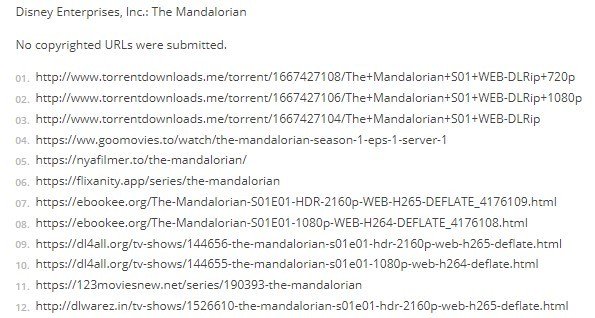
And indeed, a quick glance at various pirate sites reveals that the first Mandalorian episode, which is exclusive to Disney+, is widely available in various formats.

Over the past two days, Mandalorian has already become the most pirated TV-show, with hundreds of thousands of downloads and streams, if not more. While it is far from becoming the next “Game of Thrones,” the potential is certainly there.

The fact that Disney+ isn’t available in many countries is similar to HBO’s situation when Game of Thrones first came out. This serves as a piracy incentive. After all, people who want to watch Mandalorian in the UK, Australia, and elsewhere, have few other options than to pirate.

The limited release of Disney+ may actually breed some new pirates. Even worse, there is a chance that many of these pirates may not go legal when the streaming service officially launches in their country.

For now, Disney’s anti-piracy efforts appear to be focused elsewhere though. The company has sent takedown requests for thousands of URLs that host or link to unauthorized copies of Mandalorian. This includes notices that were sent to Google, with requests to delist these pages.

As one of the largest entertainment companies in the world, these piracy concerns shouldn’t come as a surprise to Disney. The company probably weighed the pros and cons of its actions, including the limited geographical release, as well as entering an already fragmented streaming landscape.

In today’s online streaming business, piracy is a given. Disney probably believes that running its own streaming platform will ultimately bring in more money. Piracy or not.

They may very well be right, but it will happen at the expense of others. That may include some of Disney’s competitors, but also consumers who are not willing to pirate, and those who can’t afford another subscription.

Source: TF, for the latest info on copyright, file-sharing, torrent sites and more. We also have VPN reviews, discounts, offers and coupons.



Source link


Despite some of the most intense opposition seen in recent years, on March 26, 2019, the EU Parliament adopted the Copyright Directive.

The main controversy surrounded Article 17 (previously known as Article 13), which places greater restrictions on user-generated content platforms like YouTube.

Rightsholders, from the music industry in particular, welcomed the new reality. Without official licensing arrangements in place or strong efforts to obtain licensing alongside best efforts to take down infringing content and keep it down, sites like YouTube (Online Content Sharing Service Providers – OCSSP) can potentially be held liable for infringing content.

This uncertainty led many to fear for the future of fair use, with the specter of content upload platforms deploying strict automated filters that err on the side of caution in order to avoid negative legal consequences under the new law.

While the legislation has been passed at the EU level, it still has to be written into Member States’ local law. With that in mind, more than 50 EU Academics have published a set of recommendations that they believe have the potential to limit restrictions on user freedoms as a result of the new legislation.

A key recommendation is that national implementations should “fully explore” legal mechanisms for broad licensing of copyrighted content. The academics are calling for this to ensure that the preventative obligations of OCSSPs are limited in application wherever possible.

The academics hope that broad licensing can avoid situations where to avoid liability, OCSSPs would otherwise have to prove they have made “best efforts” to ensure works specified by rightsholders are rendered inaccessible or show that they have “acted expeditiously” to remove content and prevent its reupload following a request from a rightsholder.

“Otherwise, the freedom of EU citizens to participate in democratic online content creation and distribution will be encroached upon and freedom of expression and information in the online environment would be curtailed,” the academics warn.

The academics’ recommendations are focused on ensuring that non-infringing works don’t become collateral damage as OCSSPs scramble to cover their own backs and avoid liability.

For example, the preventative obligations listed above should generally not come into play when content is used for quotation, criticism, or review, or for the purpose of caricature, parody or pastiche. If content is removed or filtered incorrectly, however, Member States must ensure that online content-sharing service providers put in place an “effective and expeditious” complaint and redress system.

The prospect of automatic filtering at the point of upload was a hugely controversial matter before Article 17 passed but the academics believe they have identified ways to ensure that freedom of expression and access to information can be better protected.

“[W]e recommend that where preventive measures [as detailed above] are applied, especially where they lead to the filtering and blocking of uploaded content before it is made available to the public, Member States should, to the extent possible, limit their application to cases of prima facie [upon first impression] copyright infringement,” the academics write.

“In this context, a prima facie copyright infringement means the upload of protected material that is identical or equivalent to the ‘relevant and necessary information’ previously provided by the rightholders to OCSSPs, including information previously considered infringing. The concept of equivalent information should be interpreted strictly.”

The academics say that if content is removed on the basis of prima facie infringement, users are entitled to activate the complaint and redress procedure. If there is no prima facie infringement, content should not be removed until its legal status is determined.

In cases where user-uploaded content does not meet the prima facie standard but matches “relevant and necessary information” (fingerprints etc) supplied by rightsholders, OCSSPs must grant users the ability to declare that content is not infringing due to fair use-type exceptions.

“The means to provide such declaration should be concise, transparent, intelligible, and be presented to the user in an easily accessible form, using clear and plain language (e.g. a standard statement clarifying the status of the uploaded content, such as ‘This is a permissible quotation’ or ‘This is a permissible parody’),” the recommendations read.

If users don’t provide a declaration within a “reasonable” time following upload, the OCSSP (YouTube etc) should be “allowed” to remove the content, with users granted permission to activate the complaint and redress procedure.

Rightsholders who still maintain that content was removed correctly must then justify the deletion, detailing why it is a prima facie case of infringement and not covered by a fair use-type exemption, particularly the one cited by the user.

A human review should then be conducted at the OCSSP, which should not be held liable for infringement under Article 17 until the process is complete and legality determined.

Given that Article 17 has passed, there appears to be limited room to maneuver and there is a long way to go before all Member States write its terms into local law.

However, even if the above safeguarding recommendations are implemented, it’s clear that substantial resources will have to be expended to ensure that everyone’s rights are protected. As a result, platforms lacking YouTube-sized budgets will undoubtedly feel the pinch.

Safeguarding User Freedoms in Implementing Article 17 of the Copyright in the Digital Single Market Directive: Recommendations from European Academics is available here.


Source: TF, for the latest info on copyright, file-sharing, torrent sites and more. We also have VPN reviews, discounts, offers and coupons.


Source link